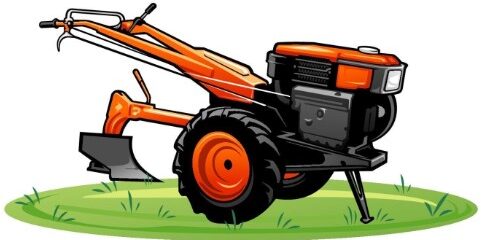
Future of Power Tilling Machines : Autonomous & Robotic

What Are Autonomous Power Tillers?
Autonomous or robotic power tillers are machines equipped with advanced sensors, GPS navigation, and AI-based control systems that allow them to operate with minimal or no human supervision. These machines can plough, till, and even perform precision inter-cultivation automatically, adjusting their depth and speed based on soil type, moisture, and crop requirements.
Some prototypes have already been developed by Indian agri-tech startups in collaboration with research institutes, signaling the beginning of a new era in mechanized farming.
Key Technologies Powering the Future Tillers
- GPS and RTK Navigation: Enables autonomous navigation and accurate field coverage within a few centimeters of precision.
- Machine Vision & AI: Cameras and sensors detect crop rows, obstacles, and soil patterns to make intelligent real-time adjustments.
- IoT Connectivity: Farmers can monitor tilling progress remotely through mobile apps, receiving real-time data on area covered, fuel consumption, and efficiency.
- Electric or Hybrid Power Systems: To reduce emissions and operating costs, some next-gen tillers are expected to use electric drivetrains or hybrid diesel-electric setups.
- Modular Attachments: Future tillers may include automatic switching between attachments like seed drills, ridgers, and rotavators, similar to the versatility discussed in our Power Tiller Attachments Guide.
Advantages of Robotic Power Tillers
Autonomous machines promise multiple benefits for Indian farmers facing rising costs and limited labor availability:
- Reduced Labor Dependency: Operates independently, freeing farmers from manual or continuous supervision.
- Higher Efficiency: Maintains uniform depth and tilling speed, improving soil consistency and reducing fuel waste.
- Data-Driven Farming: AI systems collect data on soil health, fuel consumption, and coverage area, helping farmers optimize operations.
- Lower Operating Costs: Though initially expensive, robotic systems minimize recurring labor costs and reduce maintenance errors.
- Precision Agriculture: Enables micro-level tilling and customized soil preparation for crops like turmeric, paddy, or orchards. Learn more about precision use cases in Power Tiller for Orchard Farming.
Challenges in Adopting Robotic Tillers in India
Despite the promise, several challenges need to be addressed before autonomous tillers become mainstream:
- High Initial Cost: Current prototypes and imported robotic tillers can cost upwards of ₹5–10 lakh, limiting affordability for small farmers.
- Lack of Infrastructure: Rural areas still struggle with GPS coverage, internet connectivity, and power supply needed for IoT devices.
- Maintenance Complexity: Advanced sensors and electric systems require trained technicians, which may not be easily available in villages.
- Unproven Durability: Indian soil conditions, dust, humidity, and uneven terrain pose unique challenges to delicate autonomous components.
Indian Brands & Startups Working on Smart Tillers
While large manufacturers like Honda and VST are exploring upgrades in automation, several startups are also making waves:
- AutoAgri India: Developing semi-autonomous tillers with GPS and obstacle detection systems for precision tillage.
- FarmDroid Technologies: Working on electric robotic weeders and tillers for vegetable and orchard farms.
- AgriBotix Solutions: Building modular power tillers with IoT dashboards that allow farmers to control machines remotely.
While these technologies are still in pilot stages, the pace of innovation suggests that commercial versions could reach Indian farms within the next 5–7 years.
Comparing Traditional vs Autonomous Power Tillers
| Feature | Traditional Power Tiller | Autonomous/Robotic Power Tiller |
|---|---|---|
| Operation | Manual or semi-automatic | Fully automatic with GPS and AI |
| Fuel Type | Diesel or Petrol | Electric / Hybrid Diesel-Electric |
| Labor Requirement | 1 operator | Minimal supervision |
| Efficiency | Depends on the skill of the operator | Consistent, data-optimized operation |
| Average Price Range (2025) | ₹70,000 – ₹1,50,000 | ₹5,00,000 – ₹10,00,000 (prototype stage) |
Potential Impact on Small & Medium Farms
For Indian smallholders, fully autonomous tillers may still be years away. However, semi-autonomous machines, where the farmer guides the machine remotely using a smartphone, are more likely to arrive first. These could cost around ₹2–3 lakh and may qualify for government subsidies under programs like those listed in our Agriculture Machinery Subsidy Portal Guide.
Hybrid models combining traditional diesel engines with smart navigation modules may also bridge the gap, especially for hilly and uneven farms where manual operation is challenging.
FAQs: Robotic Power Tillers in India
1. Are robotic tillers available in India yet?
Not for commercial sale. A few prototypes are being tested by research institutions and startups, but full-scale commercial deployment may take another 5 years.
2. Will robotic tillers replace farmers completely?
No. The goal is to assist farmers, not replace them. Robots will handle repetitive tasks like tilling, while farmers oversee operations and make management decisions.
3. How expensive will autonomous tillers be initially?
Early models are likely to cost ₹5–10 lakh. However, prices are expected to fall as manufacturing scales and domestic production increase.
4. Can existing tillers be upgraded with automation kits?
Yes, certain kits for GPS tracking and automatic steering may soon be available for popular models like VST or Greaves tillers.
Final Thoughts
The shift toward autonomous and robotic power tillers marks the next big leap in Indian agriculture. As the technology matures, farmers can expect smarter, more fuel-efficient, and precise machines that reduce labor dependency and increase yields. The transition may begin with semi-autonomous systems and gradually evolve toward fully robotic tillers integrated with AI and IoT platforms.
For now, investing in high-quality diesel tillers and maintaining them properly, see our Maintenance of Power Tillers guide, remains the best step for farmers preparing for the mechanized future.
Interested in learning how power tillers are evolving in India? Explore related posts like Battery Operated Power Tillers and Future Trends in Agricultural Machinery