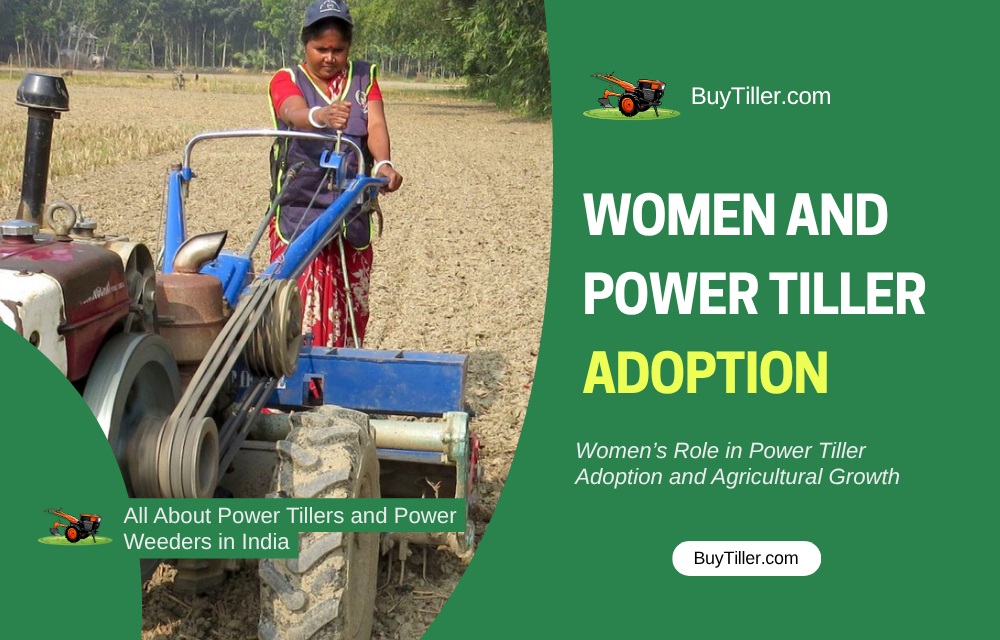
Women’s Role in Power Tiller Adoption and Agricultural Growth
Women farmers have always been the backbone of Indian agriculture. From sowing seeds to harvesting crops, their contribution remains vital, yet often under-recognized. In recent years, the introduction of power tillers has brought a silent revolution in rural India, enabling both men and women to mechanize small farms efficiently. However, the adoption of power tillers among women farmers deserves special attention, as it holds the key to improving agricultural productivity and gender equality in India’s rural economy.
The Changing Face of Indian Agriculture
According to government reports, nearly 75% of rural women in India are engaged in agriculture, either as cultivators or laborers. As men migrate to cities for non-farm jobs, women are increasingly taking charge of farm operations. But traditional tools are time-consuming and physically demanding. That’s where compact and easy-to-operate power tillers play a crucial role in transforming their daily farming routines.
Brands like VST Shakti, Kirloskar, and Honda have introduced lightweight models that make it easier for women farmers to handle various agricultural tasks, from soil preparation to weeding and ridge making.
Why Power Tillers Matter for Women Farmers
Power tillers bridge the gap between manual labor and large machinery. For women, this means:
- Reduced physical strain – Compact tillers eliminate the need for manual hoeing and digging.
- Time efficiency – A task that once took hours can be completed in minutes with a small-engine tiller.
- Economic empowerment – Women who own or operate power tillers can offer land preparation services to others, earning additional income.
- Precision farming – Using attachments such as seeders, ridgers, and weeders allows for better crop management.
For example, the 7 HP tiller range from VST and KAMCO is particularly popular among small and marginal women farmers because of its balance between power and maneuverability.
Training and Skill Development Initiatives
Many government and NGO-led initiatives now focus on training rural women to operate power tillers. Organizations such as Krishi Vigyan Kendras (KVKs) and State Agriculture Universities regularly conduct workshops on handling, maintenance, and safety. These programs not only build confidence but also encourage women to adopt mechanized farming techniques.
Several states, including Tamil Nadu, Maharashtra, and Odisha, have launched women-specific farm mechanization subsidy programs to make machines like mini tillers and small weeders more affordable. Farmers can learn more about available financial support from our detailed guide on the Agriculture Machinery Subsidy Portal.
Popular Power Tillers Suitable for Women Farmers
When choosing a tiller for female users, ergonomics and weight are as important as horsepower. Some of the most suitable options include:
- Honda FJ500 Power Tiller – Lightweight, smooth starting, and ideal for small vegetable farms.
- VST 95 DI Ignito – Offers 9 HP performance with superior balance and user-friendly controls.
- Greaves GS 75 Z – Compact diesel model preferred for multi-crop weeding and inter-cultivation.
- KAMCO KMB 200 – Popular among women’s self-help groups for cooperative farming.
All these models combine power with simplicity, making them excellent tools for village-level farming and kitchen gardens.
Women-Led Mechanization Clusters
Across India, women’s self-help groups (SHGs) have started forming farm mechanization clusters. They collectively purchase tillers, seeders, and sprayers, sharing both cost and usage. This model allows for better resource management and ensures that every member benefits from mechanized operations. Some SHGs even rent out equipment to nearby villages, turning mechanization into a small rural enterprise.
Challenges in Adoption
Despite positive changes, a few barriers remain:
- Initial cost – Even with subsidies, power tillers can cost ₹70,000–₹1,50,000, which is still significant for smallholders.
- Lack of awareness – Many women remain unaware of available schemes or local dealers.
- Limited access to maintenance services – Rural areas often lack workshops for quick repairs, though this is improving with local entrepreneurship.
- Social barriers – In some regions, traditional norms discourage women from operating machines in public fields.
Policy and Government Support
The Government of India, through initiatives like the Sub-Mission on Agricultural Mechanization (SMAM), offers special subsidies for women farmers, sometimes up to 50–60% of the equipment cost. These programs are designed to encourage participation, reduce gender disparity, and increase mechanization levels in small farms.
For those comparing models and features, reading detailed comparisons such as Power Tiller vs Mini Tractor and Power Tiller Attachments can help women buyers select machines that best match their crop type and land conditions.
Success Stories: Women Leading the Way
From Kerala to Assam, many women entrepreneurs are now recognized for their leadership in sustainable mechanized farming. For instance, in Tamil Nadu, all-women cooperatives are using battery-operated tillers for zero-emission vegetable cultivation. In Maharashtra, SHG networks use small diesel tillers for cotton and soybean fields, increasing yields by 20–30%.
These examples show that the inclusion of women in farm mechanization is not just a social initiative; it’s a powerful growth strategy for Indian agriculture.
Looking Ahead: Empowering the Next Generation
The next decade of agricultural innovation will likely see more women-focused designs, lighter frames, adjustable handles, and hybrid or electric tillers. Start-ups and manufacturers are beginning to respond to this demand, developing machines specifically suited for women farmers. This evolution aligns with India’s broader mission of inclusive agricultural growth.
Key Takeaway
Empowering women through access to power tillers is more than a matter of convenience, it’s about boosting productivity, sustainability, and rural prosperity. The road ahead involves continued training, policy support, and gender-sensitive design improvements.
FAQs on Women and Power Tillers
1. Are power tillers easy for women to operate?
Yes. Most modern models are designed with ergonomic controls and smooth-start engines, making them suitable for anyone with basic training.
2. What’s the best power tiller for small vegetable farms run by women?
Lightweight models such as Honda FJ500 and VST 95 DI Ignito are highly recommended due to their ease of handling and reliable performance.
3. Are there any special subsidies for women farmers buying tillers?
Yes. Under SMAM and state-level schemes, women can get up to 50% subsidy on eligible machines. Learn more on the Agriculture Machinery Subsidy Portal.
4. How can women learn to operate and maintain power tillers?
Krishi Vigyan Kendras (KVKs) and local agriculture departments often organize hands-on training workshops where women can learn operation and maintenance.
For more insights on selecting the right model, read:
How to Choose a Tiller for Backyard Farming and Best Power Tillers for Small Farms in India.