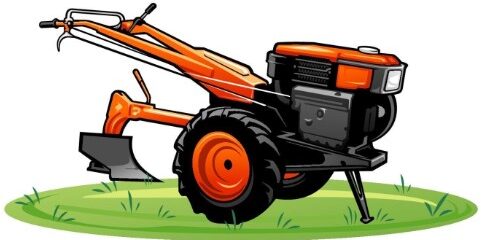
🌾 Rotary Tiller Uses in Farming: A Complete Guide for Indian Farmers
What is a Rotary Tiller?
A rotary tiller is a tractor-mounted or power-tiller-operated farm implement that uses rotating blades (tines) to dig, cut, and mix soil. It works by breaking up compact soil clods and preparing a fine seedbed for sowing. Unlike traditional ploughs, which only turn the soil, rotary tillers mix organic matter, residues, and fertilizers directly into the soil, improving fertility and moisture retention.
Key Uses of Rotary Tillers in Farming
Rotary tillers are versatile and powerful machines that have become an essential part of modern agriculture in India. From small backyard farms to large commercial fields, they simplify multiple soil-related tasks and improve overall productivity. Below are the most important uses of rotary tillers in Indian agriculture:
- 🌱 Primary and Secondary Tillage:
Rotary tillers are widely used for both breaking hard soil after harvesting and for secondary tillage operations. They crush soil clods and prepare a fine tilth, ensuring that the land is ready for sowing. This makes them suitable for crops like wheat, rice, sugarcane, and cotton, where a smooth soil structure is crucial. - 🌾 Seedbed Preparation:
A level, fine-textured seedbed is essential for better germination and crop establishment. Rotary tillers create such a seedbed in fewer passes compared to traditional implements, making them ideal for sowing cereals, pulses, oilseeds, and fodder crops. Farmers save both time ⏳ and diesel 💰 by using a rotary tiller for this step. - 🍂 Residue Management:
Crop residue burning is a serious issue in states like Punjab and Haryana. Rotary tillers help manage residues of paddy stubble, sugarcane trash, cotton stalks, and maize husks by chopping and incorporating them into the soil. This not only adds organic matter 🌿 but also improves soil fertility while reducing pollution. - 🌿 Weed Control:
Farmers often face heavy weed infestations, especially in pulses and vegetable crops. Rotary tillers uproot weeds effectively and bury them under the soil, minimizing their regrowth. This reduces the need for chemical herbicides, promoting eco-friendly farming practices. - 💧 Moisture Conservation:
In rainfed regions of India, conserving soil moisture is vital. Rotary tillers mix the upper soil layers, reducing evaporation and locking moisture in the root zone. This is particularly beneficial for crops like millets, groundnut, and soybean grown under limited irrigation. - 🍅 Horticulture and Vegetable Farming:
Rotary tillers are widely used in preparing fine, loose soil for crops such as tomato, onion, potato, brinjal, and chili. They are also used in orchards for fruit crops like mango, guava, and banana, where inter-row cultivation is needed without damaging roots. - 🌍 Soil Aeration:
Proper aeration ensures healthy microbial activity and better root penetration. By loosening compact soil, rotary tillers enhance oxygen circulation and nutrient uptake, which directly boosts crop yield and quality. - 🐂 Alternative to Traditional Ploughing:
In the past, farmers relied on bullock-drawn ploughs and harrows that required multiple passes to achieve the desired soil condition. Rotary tillers complete the same job faster, with fewer passes, saving labor, fuel, and time while delivering uniform results.
👉 Overall, rotary tillers not only save costs but also support sustainable agriculture by improving soil health, reducing residue burning, and ensuring efficient land use. This makes them one of the most valuable investments for Indian farmers today.
Benefits of Using a Rotary Tiller
Farmers across India prefer rotary tillers because they provide multiple advantages:
- ⏱️ Saves time and reduces labor compared to manual or animal-driven ploughing.
- 🌱 Ensures uniform mixing of soil and organic matter.
- 🚜 Reduces the number of field passes needed for land preparation.
- 💰 Lowers fuel costs by combining multiple operations in a single pass.
- 🌾 Enhances crop yield by improving soil tilth and seed germination rates.
Rotary Power Tiller Brands and Popular Models in India
In India, several companies manufacture and supply rotary power tillers that are suitable for small and medium farmers. These machines are compact, fuel-efficient, and designed to work effectively in Indian soil conditions. Here are some leading brands and their popular models:
- VST Tillers Tractors Ltd. – One of the most trusted names in power tillers.
- Models: VST Shakti 130 DI, VST RT 70, VST Shakti 135 DI Ultra
- Greaves Cotton – Known for durable and affordable power tillers.
- Models: Greaves GS 520 D, Greaves GS 7200, Greaves GS 920 DLX
- KAMCO (Kerala Agro Machinery Corporation) – A government-supported brand popular in southern India.
- Models: KAMCO Power Tiller Super DI, KAMCO Power Tiller STD
- Honda Power Tillers – Compact models designed for horticulture and small farms.
- Models: Honda FJ500, Honda FJ600
- Mitsuyama Power Tillers – Known for performance in vegetable and paddy fields.
- Models: Mitsuyama MY-480G, Mitsuyama MY-500
- BCS India – Italian technology adapted for Indian farms.
- Models: BCS 728, BCS 738
- George Maijo – Distributor of imported compact tillers.
- Models: George Maijo M700 ECO, George Maijo M900
- BKR & Bull Agro – Indian manufacturers focusing on affordable rotary tillers.
- Models: BKR 7 HP SC90, Bull Agro Rotary Tiller Series
How to Choose the Right Rotary Tiller
Before buying a rotary tiller, farmers should consider:
- 🚜 Tractor Compatibility: Match tiller size with tractor horsepower (HP).
- 📏 Working Width: Choose based on farm size and crop type.
- ⚙️ Gearbox Type: Single-speed or multi-speed, depending on soil hardness.
- 🛠️ Build Quality: Ensure strong blades and frame for Indian soils.
- 🛞 After-Sales Service: Check for spare parts and service availability in your region.
Best Crops for Rotary Tiller Usage
Rotary tillers can be used for multiple crops in Indian agriculture, such as:
- 🌾 Wheat
- 🌱 Paddy (including direct seeded rice)
- 🌽 Maize
- 🥜 Pulses
- 🌻 Oilseeds
- 🍅 Vegetables
- 🍌 Horticultural crops like banana, sugarcane, and plantations
Maintenance Tips for Rotary Tillers
- 🧹 Clean blades and remove residue after each use.
- ⚙️ Grease moving parts and check gearbox oil levels.
- 🔧 Inspect and replace worn-out blades regularly.
- 🚜 Tighten nuts and bolts to avoid damage during operation.
- 🏡 Store under cover to prevent rusting.
Cost of Rotary Tillers in India
The cost of rotary tillers varies based on brand, size, and features:
- 💰 Small models: ₹50,000 – ₹80,000 (suitable for 15–25 HP tractors or power tillers).
- 💰 Medium models: ₹90,000 – ₹1.5 lakh (suitable for 30–50 HP tractors).
- 💰 Heavy-duty models: ₹1.5 lakh – ₹2.5 lakh (for 50 HP and above).
Many state governments also provide subsidies on rotary tillers under farm mechanization schemes, making them affordable for small and medium farmers.
The rotary tiller has become an indispensable machine for Indian agriculture. Its ability to prepare soil efficiently, manage residues, and enhance productivity makes it a valuable investment for farmers. With multiple brands and models available, farmers can select a rotary tiller that matches their needs and budget. By adopting this technology, Indian farmers can save time, reduce costs, and achieve better crop yields. 🌾🚜